AiPBX
Signaling capture
Built by Gregory Merriweather (@shido6). Part of AiPBX itself since 1.50.8: PBX settings → Signaling. Until then it was switched by the bundled
signaling-captureplugin, which pointed Asterisk at a port nothing listened on; the update turns capture on when that plugin was on and removes it.
AiPBX ships an optional signaling pipeline: what crosses the SIP stack can be captured, kept on this server and read by the dialplan editor’s Echo box and Call quality. Capture is opt-in and off by default, so a normal installation captures nothing and pays no overhead.
Turning it on: PBX settings → Signaling → Capture On, Save. It takes effect at once (only
res_hep is reloaded; calls are not touched). The same tab sets how many days the messages are kept
and shows how many arrived in the last 24 hours.
Nothing on this path can affect a call. The capture is a UDP datagram that Asterisk sends and moves on; the daemon writes to the database in batches and survives the database going away (events are lost, capture continues).
The chain
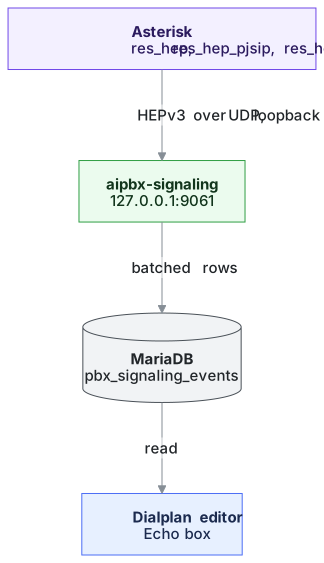
Asterisk side — hep.conf:
[general]
enabled = no
capture_address = 127.0.0.1:9061
capture_password = aipbx
capture_id = 1001
modules.conf loads res_hep.so, res_hep_pjsip.so, res_hep_rtcp.so.
hep.conf is replaced on every update; the portal’s switch is
/etc/asterisk/pbx/hep_aipbx.conf ([general] enabled = yes|no, included
after it). The address stays loopback — a capture port open to a network
turns a PBX into a free SIP sniffer for anyone who finds it.
Daemon side — python -m aipbx_signaling (installed by install.sh,
and therefore by aipbx-update on every upgrade, as
aipbx-signaling.service). Reads /etc/ai-pbx.env for database credentials
(the same file the portal reads; the asterisk group owns it). One setting
comes from sys_settings (default when absent, clamped 1..3650):
| setting | meaning |
|---|---|
signaling_retention_days |
delete events older than this (1–3650; PBX settings → Signaling) |
The daemon reads HEPv3 as specified: a 6-byte packet header and chunks with
a 6-byte header (vendor, type, length). Until 1.50.8 it read 4-byte chunk
headers, lost the last chunk — the message itself — and stored every capture
as unknown; a live Asterisk 22 datagram is now part of its tests.
Storage — pbx_signaling_events: ts, call_id, method, proto,
transport, src, dst, from_uri, to_uri, cseq, status_code, first_line, line,
capture_id, rtcp_ssrc, rtcp_lost, rtcp_fraction_lost, rtcp_jitter. Message
text is kept in first_line/line (bounded); phones still show in
from_uri. Rows are pruned by the retention setting.
RTCP counters — an RTP stream reports its own quality. res_hep_rtcp
sends each Sender/Receiver Report through the same datagram path, and the
daemon keeps the worst report block of each report in four columns, so a
quality question can be answered from the stream the PBX already sent:
| column | what it is |
|---|---|
rtcp_ssrc |
source SSRC of the worst report block |
rtcp_lost |
that block’s cumulative packet count |
rtcp_fraction_lost |
RFC 3550’s 8-bit fraction (255 = 100 %), exactly as reported |
rtcp_jitter |
ia_jitter, in RTP timestamp units — not milliseconds |
The sample rate is not part of a report, so jitter is stored raw: converting
it to milliseconds would be a guess dressed up as a measurement. NULL means
the report did not carry that counter; it is never stored as 0, which would
look healthy. SIP rows leave all four NULL.
One report can carry several blocks (one per source) and a call is as good as
its lossiest stream, so the block with the highest fraction_lost is the one
kept. The full JSON body is still not stored — the counters are the part a
decision needs.
The Echo box (AI → Dialplan editor)
The page’s “Ask about the phone system” box answers from this same data:
counts of calls (CDRs), captured SIP messages in the last 24 h, and SIP
error responses grouped by status code (400/403/404/480/486/500/503/603
…). The queries are fixed SELECTs — see
web/src/services/ai/EchoReporter.php. Nothing writes, and no packet text
leaves this server.
What stays on this server
Captured events never leave the machine: pbx_signaling_events is read by
the dialplan editor’s Echo box and Call quality, on this server. Sending
captures to an outside Homer server is not offered: Asterisk’s res_hep has
one capture address, and pointing it elsewhere stops the local capture.